


Package 1
Process
Discovery
From $900
An automation plan with fixed timelines and cost.
- Process Interview with process participants
- AS-IS diagram of the current process
- Assessment of process pain points
- TO-BE automation concept


Every business process has its own logic, so we thoroughly analyze your operations and design a solution that accounts for your company's needs and specifics.
Our automation systems are built on the Spiro low-code platform. Its flexibility lets us quickly configure solutions for specific roles, rules, and workflows. Spiro has a modular architecture, which makes it possible to start by automating a single process and gradually scale the system as the business grows.



We start with in-depth business analysis, examining roles, the tools currently in use, actions from start to finish, dependencies, and process pain points.

The project cost is fixed once the scope is agreed and doesn't change during the project. New requirements are moved to the next stage and don't affect the current budget.

With its flexibility and modular architecture, Spiro can be deployed and configured quickly for unique workflows, roles, and rules.

We have experience delivering projects of varying complexity across many industries: FinTech, manufacturing, e-commerce, healthcare, HVAC, B2B services, logistics, and others.

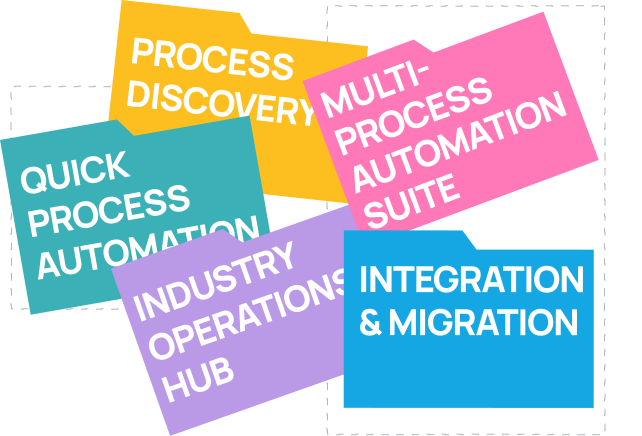
You can start automating with a single process and gradually add more. Recommended path: Quick Process → Multi-Process Suite → Industry Operations Hub.

Adding new functionality, optimizing processes based on data and user feedback, technical support, and evolving the system to meet new business requirements.

Request: sales automation. The company received three quotes: $8,000, $22,000, and $45,000. Why such a difference was unclear.
What Process Discovery revealed: the problem was in dealer onboarding: the process took 3–4 weeks with a single manager handling it. Sales automation would have cost $22,000+ but wouldn't have solved the problem.
Solution: we automated dealer onboarding for $4,500 in 4 weeks. Onboarding time dropped from 3 weeks to 4 days.
Situation: contracts took an average of 11 days to approve due to the lack of a centralized system and the use of different communication channels.
Solution: approval route: lawyer → CFO → CEO → archive. In-system comments, automatic reminders, notifications to the initiator when status changes.
Result: average approval time dropped from 11 to 2 days.
Situation: the company used several disconnected tools to manage production, procurement, sales, HR, and financial reporting.
Solution: a centralized database to streamline the work of every department: CRM, production, shipping, procurement, invoicing, accounting, HR, and an analytics dashboard for management.
Result: full transparency and control over the company's operations. No more manual data transfer between departments.
Situation: requests processed in Excel, communication with service staff in messengers, records kept in an accounting system. The dispatcher manually transfers data and assigns requests.
Solution: a dispatching system with a mobile app for technicians, an equipment registry with a maintenance schedule, a client portal, and a dashboard with AI-based failure prediction.
Result: the dispatcher now spends 30 minutes transferring data instead of 4 hours. Emergency repairs dropped by 35%.


We get into the details of your task: processes, roles, workflows, and existing infrastructure. From there, we determine the right product type and recommend where to start, and provide an estimated cost and timeline.

In-depth interviews with process participants, building an AS-IS diagram, and forming a TO-BE automation concept. The Discovery phase is included in the cost of the subsequent project.

We finalize the technical requirements and scope of work, and lock in the price and timeline. The project budget doesn't change during implementation.

We configure the system: roles, routing rules, document templates. Regular syncs keep you updated on progress, with feedback at every stage.

Final testing and training sessions for the team. Support for the first month after launch to ensure a smooth transition to the new system.

Recommended post-launch development: adding new modules, optimizing processes, and updating the system.
Yes. Regardless of business scale, the same operational challenges tend to come up: manual routine work, disconnected systems, dependency on a single person. That's why automation is relevant for processes that repeat regularly, are done manually, and slow the team down.