B2B vs. B2C Mobile App Architecture: Core Differences
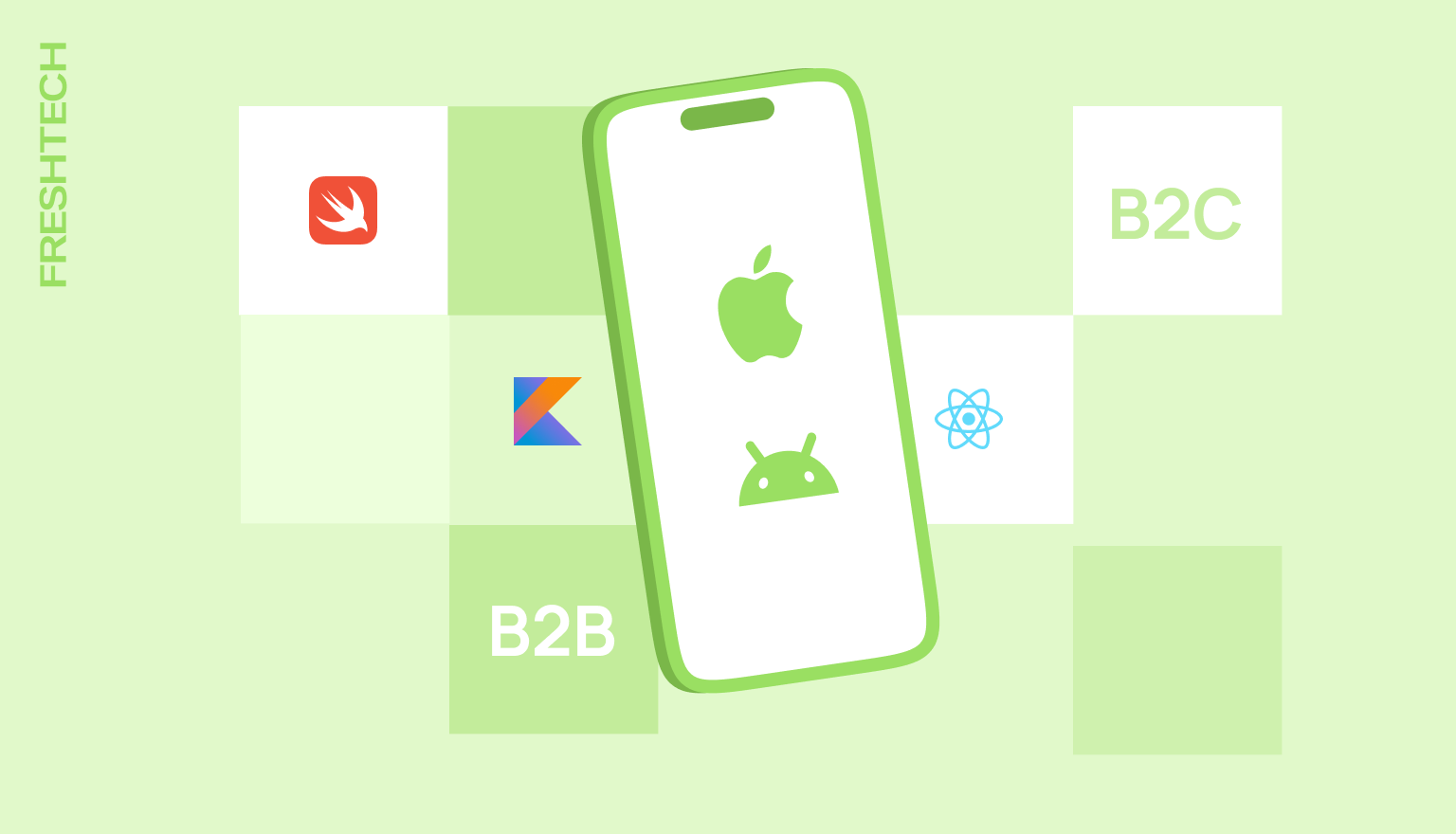
Mobile app architecture is a direct reflection of your business model. A product built for millions of anonymous users and a solution designed for a corporate team solve fundamentally different problems. In this article, we break down how these differences between B2C and B2B shape architectural decisions at every level.
👥 App audience
In B2C, the audience can range from thousands to millions of people with vastly different usage contexts. The decision to install an app is often impulsive or emotional. If the app fails to make an impression within the first 30 seconds, the user is gone. That's why architecture is built around minimizing time-to-value (TTV): guest mode without mandatory registration, aggressive caching for instant load times, and a responsive interface. Every unnecessary step in the acquisition funnel comes at the cost of conversion.
In B2B, the user represents a specific role in a defined business process — a procurement manager, warehouse operator, or financial controller. Use cases are fixed and predictable: checking inventory, approving an invoice, generating a report. There's no impulsiveness here — just routine tasks performed day in, day out. Architectural priorities shift accordingly: role-based access control (RBAC), where users have different permissions, spans the API, database, and authorization logic.
🔐 Authorization and identity management
In B2C, authorization is part of the acquisition funnel, so registration needs to be as frictionless as possible. The standard approach: sign-in via Google, Apple, or Facebook using OAuth 2.0. The app delegates authentication to an external provider and never stores passwords.
Guest mode is a separate architectural element worth noting. Users interact with the app before registering, and once they create an account, their data is linked to it. What looks simple on the surface requires support for two types of identifiers and a merging logic that needs to be built into the data schema from day one.
In B2B, authorization is inherently more complex. Corporate clients already have a centralized identity management system and expect the new app to integrate with it — not create a separate account. The standard: single sign-on (SSO) via OpenID Connect or SAML 2.0.
📁 Data management
In B2C, eventual consistency is an acceptable data model: the interface responds to user actions instantly while requests are sent asynchronously. A delay in synchronization carries no business consequences. This is why optimistic UI updates and aggressive caching are standard practice — ensuring fast load times regardless of connection quality.
In B2B, operational data must be accurate. A single error can translate into real financial losses. Field inspectors and warehouse operators often work without a stable connection, which makes offline-first architecture a core requirement: local storage acts as the primary source, with the network as a fallback.
🔗 API and integrations
In B2C, the API is designed for speed: REST with a compact payload, CDN for static content, and rate limiting at the user level. GraphQL is added where the UI requires flexible queries. API versioning is rarely needed, since the app is updated centrally through the app store.
In B2B, a breaking API change can disrupt integrations on the client's side. This makes versioning mandatory from day one. For event-driven integrations, a webhook architecture is the standard approach: the server pushes notifications to the client instead of relying on constant polling. In multi-tenant setups, the API Gateway is configured so that routing and rate limiting operate at the individual client level.
A separate challenge is integrating with legacy enterprise systems that only support older protocols like SOAP. This is a common reality when working with ERP and accounting platforms. The team either implements support for these protocols directly or builds an intermediate adapter.
✔️ Security and compliance
In B2C, security is focused on protecting the user: encryption at rest and in transit, GDPR compliance, and fraud detection based on behavioral analytics.
In B2B, the bar is higher. Corporate clients in financial, healthcare, or government sectors require adherence to established standards: SOC 2, ISO 27001, HIPAA, FedRAMP. Compliance isn't added later — it shapes the architecture from the start.
Network isolation has a direct impact on the mobile app: the corporate environment may require VPN connectivity or IP whitelisting, which needs to be accounted for at the networking layer. Compatibility with Mobile Device Management (MDM) systems is another consideration: corporate policy may restrict app installation, enforce encryption, or require remote data wiping.
In B2B, the audit log is a first-class architectural element: every action is recorded with a timestamp and user identifier, entries are immutable, and the data is available for export. Retrofitting this into an existing system is significantly harder than building it in from the start.
☁️ Scalability and deployment
In B2C, traffic is unpredictable, so the architecture is built for automatic horizontal scaling. New versions are rolled out gradually — first to a subset of users, then to everyone. Feature flags allow teams to enable functionality selectively and run A/B tests without separate releases.
In B2B, stability comes first. Updates are coordinated with the client in advance: scheduled maintenance windows, change notifications, and guaranteed recovery times. An unexpected outage during business hours is an SLA violation with financial consequences.
Deployment flexibility is another requirement: some clients demand on-premise or private cloud hosting. A related scenario is white-label: a single app customized with each client's branding, settings, and feature set. Technically, this is an extension of multi-tenancy with an additional configuration layer at the UI and business logic level.
To put it simply, in B2C architecture serves growth: speed, simplicity, and scale. In B2B, it serves reliability, control, and seamless integration to support day-to-day business operations.
Looking to launch a mobile product or streamline your team's workflows? Leave your contact details below — our manager will reach out and suggest the best solution for your business.